For Cooking Advice, Ask a Librarian: Food Literacy & Seed Sharing at the San Diego Public Library
BY Enrique Gili
January 27, 2020
Attractions
PRINT
Libraries are offering far more than computer terminals and books to borrow with new food literacy programs popping up at branches across the county.
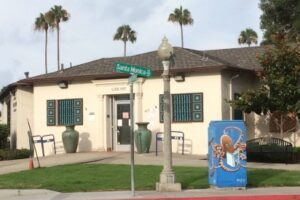
In 2019, the Ocean Beach branch of the San Diego Public Library began handing out seeds to patrons and offering workshops on plant propagation and cultivation. The idea has since ignited the passions of the locals, who now offer workshops on plant propagation and garden design. In 2020, there are tentative plans to expand the programming offered to include cooking classes and a demonstration garden on the premises.
Librarian assistant Destiny Rivera created the seed library, where non-native and heirloom seeds are now harvested and returned for safekeeping until the next growing season.
Run by library staff and volunteers, Rivera’s goal is to provide garden plots on-site so patrons can grow fruits and vegetables to share with like-minded community members.
Thus far, 200 patrons have registered with the seed library, and 70 gardens are participating in the project. Whether by design or chance, the librarians acknowledge they’ve tapped into a need for programming that tells the story of food and the people who coax plants from the ground.
Classes and workshops are also offered, such as the late-season canning workshop that drew OB resident Karen Kutcher to the library on a recent sunny Saturday afternoon. Her fig tree was producing more fruit than she could consume, and she needed help. “I’ve canned and preserved fruit before, but the workshop was a chance to learn more from an expert,” she explained.
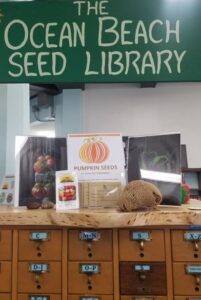
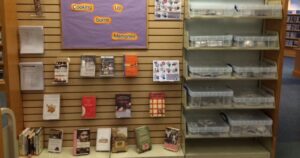
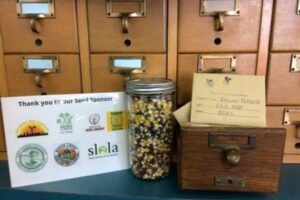
“We have families that come in, and they’re pleasantly surprised to find a seed library here,” Rivera said. Patrons can peruse a card catalogue of dozens of seed varieties, both native and non-native, which are indexed and catalogued according to species. Below are resources for every age group on seed collecting and plant propagation.
Rivera was inspired to create the seed library in Ocean Beach after attending a 2018 conference on seed exchanges and food sovereignty, where she learned about the pioneering work of food activists such as the Chia Cafe Collective. The Southern California group focuses on collecting native seeds as an educational and cultural practice.
“I was floored by the possibility of using the library as a forum for knowledge exchange,” she said.
These seed libraries are a form of resistance to multinational seed companies. After decades
of consolidation, four companies—Corteva, ChemChina, Bayer, and BASF—control 60 percent of seed sales worldwide. Seed libraries offer a counterpoint to the corporate control of germplasm.
Food literacy programming is not exclusive to the Ocean Beach branch. Due to popular demand, a second seed library has opened in the Scripps Miramar Ranch suburb. Nationally, librarians manage approximately 500 community-based seed libraries in the United States, with thousands more offering food literacy programming across food production, gardening, and cooking.
In Berkeley, librarians lend gardening tools and seeds to patrons, and at branches in Topeka, Kansas, patrons can find digitized catalogs of various baking pan designs.
While the idea of food literacy means many things to different people involved with the food-o-sphere, according to Colorado librarian, Hillary Dodge, the author of “Gather ‘Round the Table: Food Literacy Programs, Resources, and Ideas for Libraries,” the concept revolves around knowing the how’s and why’s of food production, kitchen skills and the links between health, farming, and the environment.
“Food literacy is all of that tied together,” said Dodge, who manages five libraries in Colorado Springs.
While researching her book, Dodge received input from several thousand librarians nationwide on what food literacy meant to them. It revealed food literacy programs that were as varied as the communities they served, yet all were uniformly popular with patrons.
At one time, libraries might have been a place to find a book on baking; now they may also be a place to participate in a workshop on cake making or on creating a business plan to open a cake shop.
“Whenever I try to sell librarians on the primacy of food literacy, I mention the maker movement. Cooking is another form of making, but using different equipment,” she said.
Part of the impetus for her book was to help ease libraries into a new era of innovation and discovery, as notions about what a library can be and who it should serve begin to fall by the wayside.
In Dodge’s town, the library system has partnered with Colorado Springs’ workforce development agency to launch a kitchen skills certification program offering free training courses led by industry professionals to help budding chefs and kitchen staff. In rural Oklahoma, library staff developed cooking classes for Native American teens caring for their siblings. For others, food literacy involves creating pathways to employment with skill-oriented workshops.
“Libraries are champions of social good and intellectual freedom,” she explained. “Food literacy is just another component of what we’re already doing.”
“Over the past decade, libraries have become a more participatory experience, and food literacy is a part of that hands-on learning experience,” said Kelly Pepo, a supervisor with San Diego Public Library. Given San Diego’s size and diversity, this has meant tapping into a broad range of interests, from vegetarian cooking to food science.
Recent programming has included workshops on making edible slime and the history of Chinese food in America.
Pepo points to the intergenerational knowledge gap as one factor that makes this programming so vital. “Some of the elements of food literacy were not something you had to wonder about twenty or thirty years ago; it was an automatic part of your education,” she said.
The latest workshop to take the San Diego Public Libraries by storm is the vegan cookery course. Due to popular demand, twenty-five libraries across the county are demystifying animal-free cooking techniques. “We are a la carte society, and we have to surprise people,” she said.
The workshops and collections may be what draw many people in, but books also remain a major part of food literacy, from cookbooks to chef confessions in the form of a memoir, to wellness guides, and gustatory passages on the pages of novels.
In our modern world, we may no longer turn to grandma when we have a question about how to make a pie crust, but instead turn to the local librarian for answers.
Visit Your Local Public Library to Learn More About Food Literacy Programs
Enrique Gili is a freelance writer based in San Diego covering environmental issues in the Southland and beyond. He focuses on the intersection between nature, science, and technology with a side order of food politics.
In 2019, the Ocean Beach branch of the San Diego Public Library began handing out seeds to patrons and offering workshops on plant propagation and cultivation. The idea has since ignited the passions of the locals who now offer workshops on plant propagation and garden design. In 2020, there are tentative plans to expand the types of programing being offered to include cooking classes and a demonstration garden on the premises.
Librarian assistant, Destiny Rivera, created the seed library where nonnative and and heirloom seeds are now harvested and returned to the library for safekeeping until the next growing season.
Run by library staff and volunteers, Rivera’s goal is to have garden plots available on the premises so patrons can grow fruits and vegetables to share with like-minded community members.
Thus far, 200 patrons have registered with the seed library and 70 gardens are participating in the project. Whether by design or chance, the librarians admit that they’ve tapped into a need for programming that tells the story of food and of the people that coax plants out of the ground.
Classes and workshops are also offered, like the late-season workshop on canning that drew OB resident Karen Kutcher to the library on a recent sunny Saturday afternoon. Her fig tree was producing more fruit than she could consume, and she needed help. “I’ve canned and preserved fruit before, but the workshop was a chance to learn more from an expert,” she explained.
“We have families that come in and they’re pleasantly surprised to find a seed library here,” Rivera said. Patrons can peruse a card catalogue of dozens of seed varieties, both native an non-native, which are indexed and catalogued according to species. Below the seeds are resources for every age group on seed collecting and plant propagation.
Rivera was inspired to create the seed library in Ocean Beach after attending a conference on seed exchanges and food sovereignty in 2018, where she learned about the pioneering work of food activists like the Chia Cafe Collective. The Southern California group focuses on the collection of native seeds as an educational and cultural practice.
“I was floored by the possibility of using the library as a forum for knowledge exchange,” she said.
These seed libraries are a form of resistance to multinational seed companies. After decades
of consolidation, four companies—Corteva, ChemChina, Bayer and BASF—control 60 percent of seed sales worldwide. Seed libraries offer a counterpoint to the corporate control of germplasm.
Food literacy programing is not exclusive to the Ocean Beach branch. Due to popular demand, a second seed library has opened in the suburb of Scripps Miramar Ranch, and nationally, librarians manage approximately 500 hundred community-based seed libraries in the United States, with thousands more offering some form of food literacy programming on every aspect of food production, gardening, and cooking.