Step Into the Garden of Permaculturist, Cadence Baron
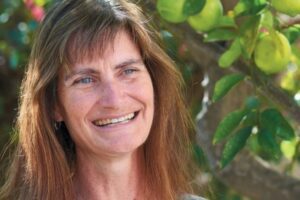
Cadence Baron apologizes for the current state of her garden, explaining that she has recently returned from a three-week trip to Cuba. The garden didn’t seem to mind her absence, since gardens don’t mind being left to do their thing. The winter morning light darkens some of the overgrowth, revealing work to be done.
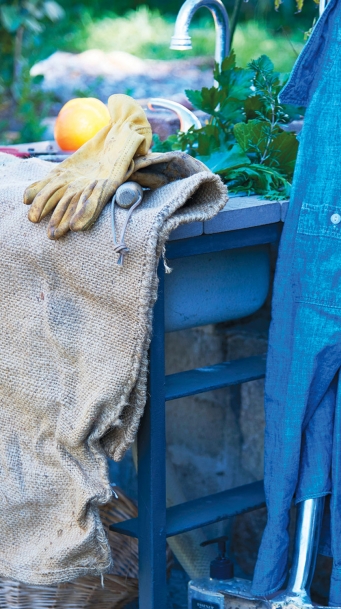
The garden, a microfarm affectionately referred to as Ripe Next Door, is exceptional to behold in its untamed state, bursting with life in all its phases. Some of it is just beginning to grow, and some of it is being returned to the soil. To call this place a garden doesn’t do it justice. Everything in this yard is part of a cycle, its own ecosystem.
Standing back and gazing into the backyard as you enter through the gate, plants, trees, and bushes roll out before your eyes like the layers of a mountain range. Butterflies flutter above, lizards scurry, and a deep breath in reveals the smell of dead, wet leaves. This place is beyond its own ecosystem; it’s its own little paradise.
This special plot of earth has been tended to for eight years by Baron and her mother, Elaine. “You could say I’m an industrial engineer, of sorts,” Baron says of her occupation with a laugh.
Currently employed by the San Diego Unified School District, Baron designs and builds assistive and adaptive technology devices for the district’s special education department. The Minnesota transplant otherwise describes herself as an avid runner, singer, and ukulele player.
After routinely fleeing the cold, dark Minnesota winter every January, Baron moved to San Diego 13 years ago and spent her first 5 years living on a boat. Both Baron and her mother care for the garden, a specimen to behold of the city’s permaculture movement.
Baron said that they both had to relearn everything they previously knew about gardening after moving from Minnesota, “since things that grow there don’t grow here.” Inspired by Sepp Holzer’s book, Permaculture: A Practical Guide to Small-Scale, Integrative Farming and Gardening, she applied natural agricultural practices to transform this incredible space.
An Italian stonemason and bocce ball lover named Amedeo DiCola was one of the original owners of the La Mesa home that accompanies the garden. Large portions of the house and yard are built from leftover materials that DiCola acquired at various job sites over the years. The most unique feature in the outdoor space is a massive, granite fireplace with a pizza oven, where DiCola was known for roasting goats. The space continues to serve as a large gathering place for friends, food, and entertainment.
The fireplace and concrete retaining walls are among the few remaining features of the existing yard. The Barons acquired the property after it went through foreclosure and moved in in 2008. The property had not been well cared for, and the grass plots and a bocce ball court wasted the large space.
Baron and her mother engineered the home and garden for self-sufficiency, adding solar power and building greywater and rainwater systems. No fewer than eight rainwater barrels are scattered around the property, supplementing the microfarm’s water supply, which is fed through a drip irrigation system.
Following Baron around the garden, she explains that she covered all the existing grass with cardboard and four inches of woodchips to begin rebuilding the soil. This led to an earwig plague, later corrected by bringing in lizards that now reside in little terracotta houses. Baron’s mother spent several weeks taking down a 30-foot-tall Magnolia tree in pieces by hand. After poor planting and years of bad pruning, few of the existing trees were well enough to survive. Baron and her mother salvaged the few trees they could, and the garden grew from there.
And grow it did. The crop variety is mind-blowing. Every plant seems to have a purpose. Ornamental varieties are there to be beneficial, Baron explains, while pointing out how she leaves the delicate sweet peas seen shooting up throughout the garden on their own agenda to help correct nitrogen in the soil.
The edible varieties grow in dizzying quantities and seem beautifully exotic, forming complementary plantings that foster and strengthen symbiotic relationships.
A small field of mint grows under a Valencia orange tree, while varieties of berries grow by a pine, whose needles help to deter slugs and keep the soil cool.
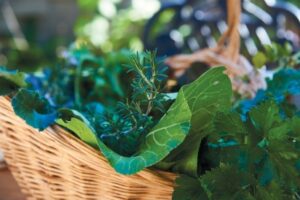
Baron purchases very few groceries. She regularly eats meals just grazing in the garden on fruits and vegetables, including: blueberries, blackberries, boysenberries, raspberries, strawberries, pineapple and strawberry guavas, Valentino pomelos, tangelos, tangerines, limes, lemons, dwarf peaches and nectarines, kumquats, four varieties of loquats, three varieties of pears, nectaplums, pomegranates, papayas, rose apples, figs, avocados, mangoes, cape gooseberries, bananas, apricots, Valencia oranges, Navel oranges, California Concord grapes, tomatoes, almonds, dragon fruit, sweet potatoes, blue potatoes, yacón, tatsoi, bok choy, broccoli, eternal spinach, artichokes, fava beans, peppers, onions, fennel, kale, and more.
Baby lettuce sprouts peek out of the bark throughout the garden’s trails, which will be gathered to replant where the lettuces grow better. Baron gathers sprouts from her compost in the same efficient manner and notes that she lets everything in her garden go to seed, allowing plants to grow back on their own. “The garden maintains itself,” she says. As the garden replants itself, it helps to maintain more shade for the soil.
Baron, a San Diego Master Gardener, explains that her garden is not a pretty garden. It’s a functional garden. “I want nature in my garden,” she says. “I don’t want to fight that. I want to let it grow.”
Maria Hesse
Maria Hesse is the executive editor and designer of Edible San Diego. Her interest in the functional arts led to a degree in interior design, which inspires her passion for advocating for sustainable living through food. She enjoys balcony gardening and designing crochet patterns in her downtime. Find her @mariafromediblesd and @waysidestudiowest on Instagram.
Cadence Baron apologizes for the current state of her garden, explaining that she has recently returned from a three week trip to Cuba. The garden didn’t seem to mind her absence, since gardens don’t mind being left to do their thing. The winter morning light darkens some of the overgrowth, revealing work to be done.
The garden, a microfarm affectionately referred to as Ripe Next Door, is exceptional to observe in its untamed state, bursting with life in various phases. Some of it is just beginning to grow and some of it is being returned to the soil. To call this place a garden doesn’t do it justice. Everything in this yard is part of a cycle, its own ecosystem.
Standing back and gazing into the back yard as you enter through the gate, plants, trees, and bushes roll out before your eyes like the layers of a mountain range. Butterflies flutter above, lizards scurry, and a deep breath in reveals the smell of dead, wet leaves. This place is beyond its own ecosystem, it’s its own little paradise.
This special plot of earth has been tended to for eight years by Baron and her mother, Elaine. “You could say I’m an industrial engineer, of sorts,” Baron says of her occupation with a laugh.
Currently employed by the San Diego Unified School District, Baron designs and builds assistive and adaptive technology devices for the district’s special education department. The Minnesota transplant otherwise describes herself as an avid runner, singer, and ukulele player.
After routinely fleeing the cold, dark Minnesota winter every January, Baron moved to San Diego 13 years ago, spending her first 5 years living on a boat. Both Baron and her mother care for the garden, a specimen to behold of the permaculture movement in the city.
Baron said that they both had to relearn everything they previously knew about gardening after moving from Minnesota, “since things that grow there don’t grow here.” She became inspired by Sepp Holzer’s book, Permaculture: A Practical Guide to Small-Scale, Integrative Farming and Gardening, applying the natural agricultural practices to convert this incredible space.
An Italian stonemason and bocce ball lover named Amedeo DiCola was one of the original owners of the La Mesa home that accompanies the garden. Large portions of the house and yard are built from leftover materials that DiCola acquired at various job sites over the years. The most unique feature in the outdoor space is a massive, granite fireplace with a pizza oven, where DiCola was known for roasting goats. The space continues to serve as a large gathering place for friends, food, and entertainment.